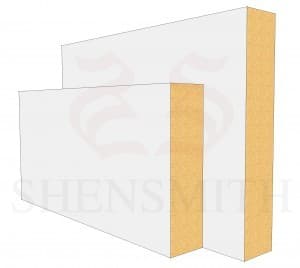
The simplest outline
Square-edge skirting has a straight, plain outline rather than a curved or stepped decorative top. The effect depends heavily on its height, thickness and surface finish. With no ornate moulding, changes in alignment or an uneven wall junction can be especially visible.
Plain does not mean proportion-free
A short square-edge board can read as a quiet trim; a taller board can make a stronger horizontal band around the room. Test paper strips or a sample against the wall and check the relationship with sockets, door surrounds and furniture.
Compare the edge treatment
Some nominally square profiles have a slight eased edge rather than a perfectly sharp corner. This small detail can affect how an existing length matches. Check the actual sample, especially if several rooms are intended to have continuous joinery.
Plan the finish and joints
A broad plain face highlights filling and decorating. Keep joints flush, follow the coating guidance for the chosen material and avoid sanding a visible dip around a repair. Confirm the intended corner detail and door-frame junction before cutting.
Materials, sizes and enquiries
MDF and timber behave differently and suit different finishing approaches. Compare the material and actual sample before choosing. Confirm the available height, thickness, length and finish for your enquiry; this profile directory does not establish current stock or a fixed product specification.
Your questions, answered.
Does square edge mean the corner is perfectly sharp?
Not necessarily. Some boards have slightly eased edges. Inspect the actual section when a precise match matters.
Can plain skirting suit a traditional room?
It can, depending on the existing joinery and proportions. Consider the room as a whole rather than treating a profile name as a rule about architectural period.